
Earth and Space Grades 6 to 8
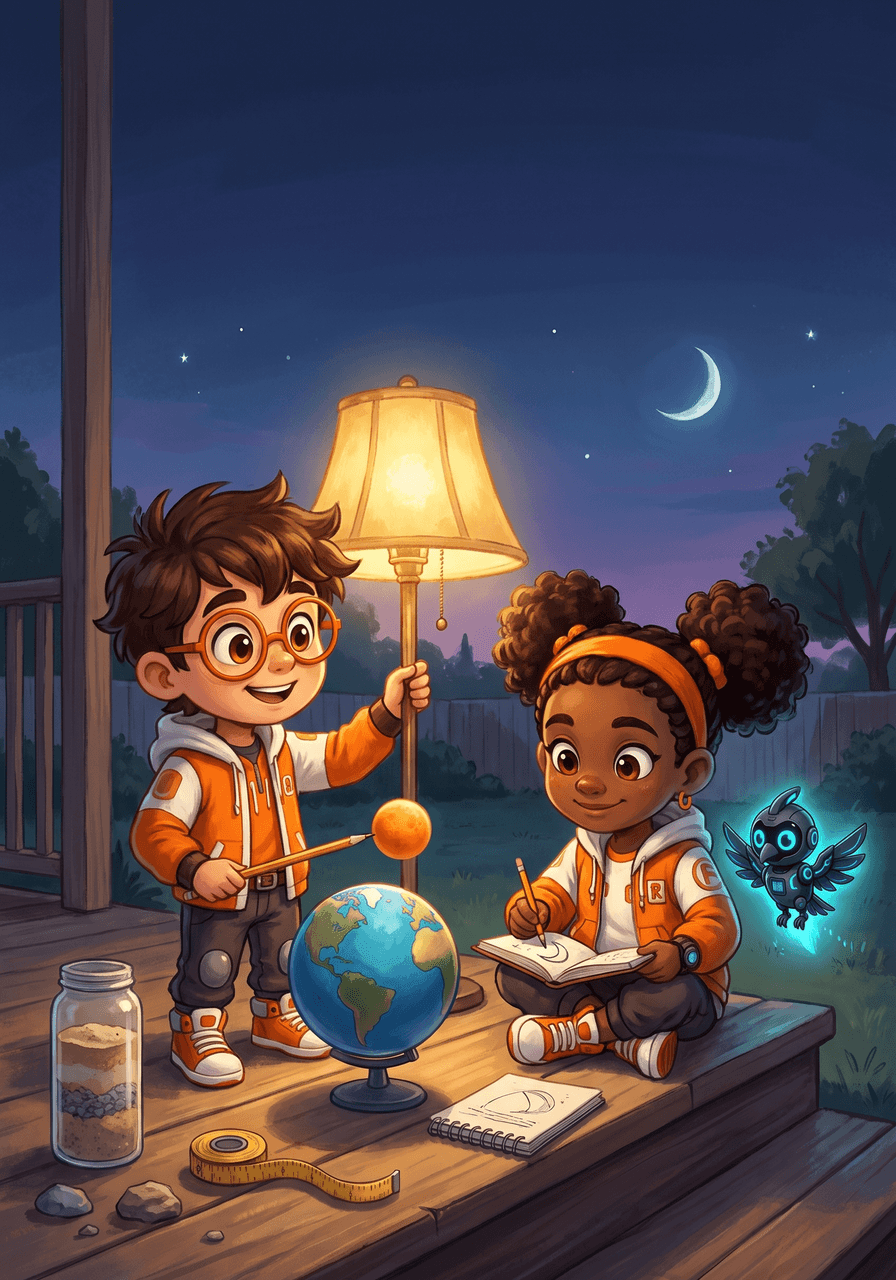
Turn a window or porch step into a Sky Deck: day and night, Moon phases, eclipses, seasons, gravity, the scale of the solar system and Earth's deep past, modeled with a lamp, a ball and a jar of sand, with Rocket, Raven and Nova.
Free, start to finish. No card. Every week opens without signing in.
- Grade
- Grades 6 to 8
- Length
- 12 weeks
- Pace
- 6 short lessons a week, about 20 minutes each
- Price
- Free, every week
About this course
Earth and Space Grades 6 to 8 is a 12-week Earth and space science course for middle schoolers that uses only things a family already has: a flashlight or lamp, two balls, paper and a pencil, a tape measure, string, a plastic bottle with sand and soil, a roll of toilet paper and a few rocks from a walk. Students set up the Sky Deck at home and keep a Sky Log. Week by week they model why the Sun rises and sets, reproduce the Moon's phases with a lamp and a ball, cast the shadows that make eclipses, show with a slanted flashlight why tilt makes the seasons, roll a marble to see how gravity holds the solar system together, model the disk of dust and gas it formed from, walk the distances between planets to scale, cut planet sizes from paper using NASA data, sort rocks by how they formed, settle layers of sand and soil to read Earth's history from the bottom up, and unroll a timeline of 4.6 billion years down the hallway. The course ends with a scale model of the solar system the student designs, builds, measures and improves for the family. Short daily lessons with checked answers, a hands-on Sky Deck Lab each week and a Saturday Sky Night for the family. 100% free, start to finish.
Kids will
- Use a lamp-and-ball model to explain day and night, the phases of the Moon and solar and lunar eclipses
- Explain the seasons from the tilt of Earth's axis and the changing intensity of sunlight, not from distance
- Describe the solar system as the Sun and the objects its gravity holds in orbit, and how it formed from a disk of dust and gas
- Read NASA data tables to compare the distances, sizes and properties of the planets and build scale models from them
- Describe how rocks change from one type to another and how rock layers and fossils give relative dates for Earth's history
- Place Earth's 4.6-billion-year history on a scale timeline, and design a solar system model from criteria and constraints
The 12 weeks
-
Week 1
Day and Night
We ride a spinning Earth
-
Week 2
Moon Phases
The lit half seen from changing angles
-
Week 3
Eclipses
When the shadows line up
-
Week 4
Seasons
A tilted axis that always points the same way
-
Week 5
Gravity Holds the System
One pull keeps the whole solar system together
-
Week 6
A Disk of Dust and Gas
How a spinning cloud became a solar system
-
Week 7
How Far: Distances
Walking the solar system one step at a time
-
Week 8
How Big: Sizes and Properties
Reading the planets as a data table
-
Week 9
Rocks Change
Energy flows, matter cycles, rocks turn into other rocks
-
Week 10
Reading the Layers
Oldest at the bottom, youngest on top
-
Week 11
Earth's Long Story
Four and a half billion years on one roll of paper
-
Week 12
Design a Solar System Model
Criteria, constraints, build, measure, improve
Try Week 1 today.
Open the course, pick Day 1 and go. Make a free parent account when you want progress saved for each kid.