
Cells and Systems Grades 6 to 8
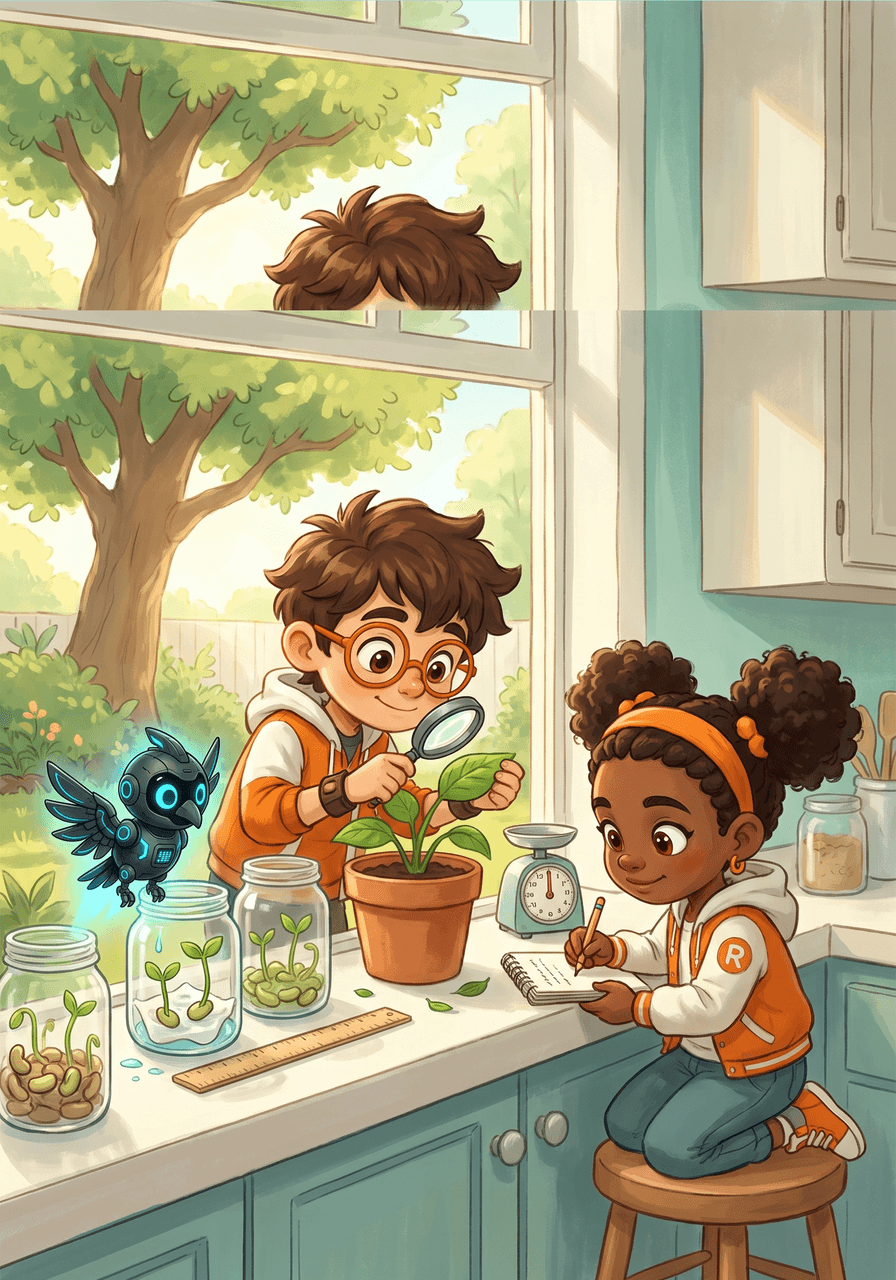
Turn a kitchen windowsill into a life-science lab: cells, body systems, senses, photosynthesis and growing things, investigated with jars, seeds, a hand lens and a timer, with Rocket, Raven and Nova.
Free, start to finish. No card. Every week opens without signing in.
- Grade
- Grades 6 to 8
- Length
- 12 weeks
- Pace
- 6 short lessons a week, about 20 minutes each
- Price
- Free, every week
About this course
Cells and Systems Grades 6 to 8 is a 12-week life-science course for middle schoolers that uses only things a family already has: glass jars, paper towels, dried bean seeds, a hand lens, a ruler, a timer, a flashlight and a flower or leaf from outside. Students set up the Windowsill at home and keep a Windowsill Log. Week by week they sort living from non-living, watch single cells make a balloon rise, build a cell model, compare plant and animal cells, follow cells to tissues to organs with their own pulse, feel body systems work together after a run, test their reaction time and memory, trap a leaf in the dark to see what light does, model how food is taken apart and rebuilt, grow seeds in light and dark, and look at how flowers, seeds and nests help living things make more of themselves. The course ends with a windowsill growing station designed, built, tested and improved. Short daily lessons with checked answers, a hands-on Windowsill Lab each week and a Saturday Nature Day for the family. 100% free, start to finish.
Kids will
- Give evidence that living things are made of one cell or many cells and tell living things from non-living things
- Describe a cell as a working system and the jobs of the nucleus, membrane, mitochondria, chloroplasts and cell wall
- Explain how cells form tissues, tissues form organs, and body systems work together, using your own pulse and breathing data
- Describe how senses send signals to the brain for quick action or memory, using a reaction-time test
- Trace matter and energy through photosynthesis and through food that is taken apart and rebuilt in the body
- Explain how environment and inheritance shape growth, how living things make more of themselves, and design a growing station from criteria and constraints
The 12 weeks
-
Week 1
Living or Not
What every living thing does
-
Week 2
One Cell or Many
Living things, from one cell to trillions
-
Week 3
Inside a Cell
A cell is a system of parts
-
Week 4
Plant Cells Have More
Cell walls, chloroplasts and the color green
-
Week 5
Cells to Tissues to Organs
Levels of organization in a living body
-
Week 6
Systems Work Together
Lungs, heart and muscles share one job
-
Week 7
Senses and Signals
Receptors notice, the brain decides
-
Week 8
Plants Make Food
Light, air and water become sugar
-
Week 9
Food Becomes You
Molecules broken apart and put back together
-
Week 10
Growing Up: Environment and Inheritance
Two kinds of factors shape every living thing
-
Week 11
Making More
Structures and behaviors that help life continue
-
Week 12
Design a Growing Station
Criteria, constraints and the Cells and Systems report
Try Week 1 today.
Open the course, pick Day 1 and go. Make a free parent account when you want progress saved for each kid.